
PISA Study materials, Question papers and Handbooks
PISA Study Materials for 2021
- PISA 2021 Context Questionnaires Framework
- PISA 2021 CREATIVE THINKING FRAMEWORK
- PISA 2021 FINANCIAL LITERACY ANALYTICAL
- PISA 2021 ICT Framework
- PISA-2021-MATHEMATICS FRAMEWORK
- PISA 2018 financial literacy By OECD
- PISA 2018 Released by OECD Paris
- PISA 2015 Cognative Guide by OECD Paris
- PISA 2015 Cognative Literacy by OECD Paris
CBSE: PISA Hand Book for Teachers
PISA Study Materials VI to X
- Take the test e-book materials
- English e-book Test materials
- Maths e-book Test materials
- Science e-book Test materials
- PISA Test materials Sample Q Paper
- PISA By KPMG Test Materials
- Joy full learning Activity
PISA Study Materials Question VI to X
- PISA – CCT Final CLASS-6
- PISA – CCT Final CLASS 7
- PISA – CCT Final CLASS 8
- PISA – CCT Final CLASS 9-10
- ANSWER NER SCINCE
- CCT Class IX Mathematical Literacy
- CCT Class VI-VIII Scientific Skills
- CCT Mathematical Skills
- CCT Scientific Skills VI-VIII-4pdf
- CCT Scientific Skills VI-VIII.-5pdf
- CCT Scientific Skills VI-VIII.-6pdf
- CCT Scientific Skills VI-VIII.-7pdf
- CCT Scientific Skills VI-VIII
- PISA CLASS IX- Scientific Skill
- PISA CLASS IX-X Scientific Skills
- NER ANSWERS
- PISA Scientific Skills
- PISA Scientific Skills IX-X
- Reading Literacy PISA 2
- Reading Literacy Skills PISA-1
- SCIENTIFIC LITERACY PERIODIC TABLE
- SCIENTIFIC LITERACY PISA
- Scientific Skills_Pisa_questions_
Class VI & IX SLET Paper
- Class VI Maths MCQ Class VI Science MCQ
- SLET Class VI Science 2018
- SLET Class VI English 2018
- SLET Class VI Maths 2018
- SLET Class IX English 2018
- SLET Class IX Maths 2018
- SLET Class IX Science 2018
- SLET Class IX Social Science 2018
PSA CLASS VI to VIII
- Class VI Problem Solving Assesment
- MCQ SCIENCE CLASS VI
- Microsoft Word – hotsscience.html
- PSA-Model-Paper-Class_6
- psa-sample-paper-for-class-viipsa-class-7th
- PSA Class VII Model paper
- problem-solving-assessmentpsa-class-viii-class-8
Courtesy: Collected by S. K. Verma, Librarian, KV Sitapur (U.P)
The Programme for International Student Assessment is a worldwide study by the Organisation for Economic Co-operation and Development in member and non-member nations intended to evaluate educational systems by measuring 15-year-old school pupils’ scholastic performance on mathematics, science, and reading. Wikipedia
Formation: 1997
Parent Organization: OECD
Main Organization: PISA Governing Body (Chair – Michele Bruniges)
Purpose: Comparison of education attainment across the world
Official Language: English and French
Headquarters: OECD Headquarters
Membership: 79 government education departments
What is the PISA for Schools project?
The PISA for Schools project contributes to improving student learning opportunities and well-being by empowering teachers and school leaders through global connections and international benchmarking based on a common scale provided by the OECD’s Programme for International Student Assessment (PISA). The PISA for Schools project has two main goals: (1) to provide the PISA-based Test for Schools on demand; and (2) to develop opportunities for global peer-learning on improving learning outcomes.
The PISA-based Test for Schools is a voluntary assessment intended to help school leaders from across the world understand their 15-year old students’ abilities to think critically and apply their knowledge creatively in novel contexts.
What is PISA?
PISA is an international study that was launched by the OECD in 1997, first administered in 2000 and now covers over 80 countries. Every 3 years the PISA survey provides comparative data on 15-year-olds’ performance in reading, mathematics and science. In addition, each cycle explores a distinct “innovative domain” such as Collaborative Problem Solving (PISA 2015) and Global Competence (PISA 2018). The results have informed education policy discussions at the national and global level since its inception.
What is the relationship between the PISA-based Test for Schools and PISA?
While PISA is intended to deliver national level results, the PISA-based Test for Schools is designed to deliver school-level results for school improvement and bench marking purposes. Because both assessments are based on the same framework, the results are comparable, meaning that individual schools benchmark their performance with that of national education systems from around the world.
Why compare school-level results internationally?
Given our global, knowledge-based economy, it has become more important than ever before to compare students not only to local or national standards, but also to the performance of the world’s top-performing school systems. There has been growing interest in comparing student performance to international benchmarks, both as a gauge of how prepared students are to participate in a globalized society and as a means of setting targets above and beyond basic proficiency levels or local expectations.
What are the goals of the PISA for Schools project?
The PISA for Schools project aims to:
- Empower school leaders and teachers by providing them with evidence-based analysis of their students’ performance.
- Measure students’ knowledge, skills and competencies that will equip them for success in education and the world of work.
- Provide valuable information on the learning climate within a school, students’ socioeconomic background and motivation for learning.
- Help schools measure a wider range of 21st century skills beyond maths, reading and science.
- Provide opportunities for global peer-learning among teachers and school leaders.
What are the benefits for schools of participating in the PISA for Schools project?
To date, the assessment has been delivered in more than 2 200 schools cumulatively. School leaders and teachers have reported using results to:
- Benchmark their performance in a global setting. Schools are using the results to set goals against the best school systems worldwide and to create a greater sense of urgency to push for higher levels of achievement.
- Better understand the challenges faced by low-performing students.
- Create peer-learning communities and networks with other schools and teachers.
How is the PISA-based Test for Schools administered?
OECD-accredited organisations are responsible for the implementation of the assessment. Under rigorous technical oversight from the OECD, the accredited National Service Providers (NSPs) administer the assessment to schools using a digital platfrom run by the International Platform Provider (IPP).
Students respond to approximately two hours of test questions in reading, mathematics and science and answer a 30-minute student questionnaire. The testing experience for a student lasts approximately three to three-and-a-half hours, including instructions and break periods.
In addition, school leaders (e.g. principals and directors) of participating schools will be asked to provide information on their school by filling out a questionnaire.
How are the results reported?
Schools participating in the PISA for Schools project, receive a comprehensive report in electronic format detailing their school’s performance measured against national PISA results from their own country and those of others around the world. School networks and governments can select the countries with which they wish to be compared, based on common challenges or goals. The data collected, and the school reports generated as a result of the assessment belong to each school, which decides to what extent the data can be reported by the OECD. Schools are encouraged to share and discuss their results with teachers, staff, students and parents to foster deeper understanding of the overall performance of their school as a basis for future action.
To be eligible to receive a school report, schools have to have tested a minimum number of 42 eligible students (i.e. those who are aged between 15 years and 3 completed months to 16 years and 2 completed months at the time of testing). To ensure that the minimum number of 42 students per school is reached, it is recommended to test at least 55 students, assuming a participation rate of 80%.
Why does the project discourage rankings amongst schools?
The PISA-based Test for Schools and its results are not meant to be interpreted or used as school rankings or for “league tables”. The PISA-based Test for Schools does not provide for student level performance reporting and is designed principally to support school improvement efforts.
How does the OECD monitor quality?
The OECD accredits professional assessment bodies to act as National Service Providers (NSPs) for the PISA-based Test for Schools in each country. They are obliged to adhere to the provisions set out in the OECD Technical Report and PISA for Schools General Guidelines for Use and Availability.
The PISA for Schools General Guidelines for Use and Availabilty sets out clear principles intended to guide the use of the assessment as a tool for improvement and informed discussions. Where the Guidelines are not respected, the OECD reserves the right to withhold its approval of a school report and the use of the OECD logo.
What is the frequency of testing?
Once the validation study in a given country is complete, the test can be delivered “on-demand”. That is to say, schools can choose to administer the test at their desired frequency and up to once per school year. The PISA-based Test for Schools cannot be offered during the months in which the main PISA study conducts its data collection, which happens every 3 years in each participating country.
How can my school participate in the PISA for Schools project
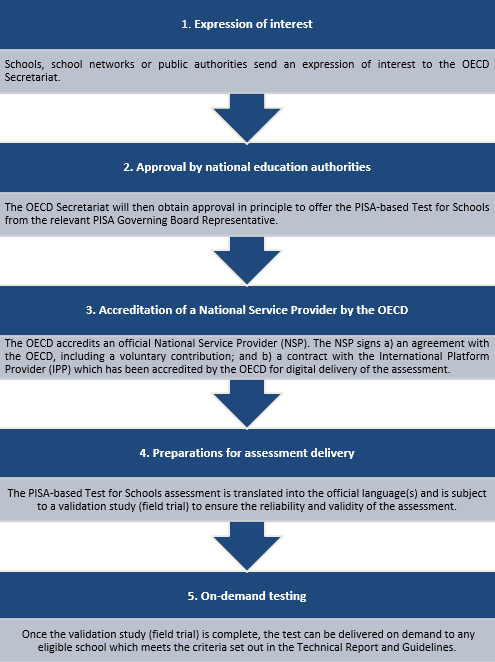
What costs are associated with taking part in the PISA for Schools project?
For details regarding costs, please contact a member of the OECD PISA for Schools team at pisaforschools@oecd.org.
What does the future hold for the PISA for Schools project?
Looking ahead, the PISA for Schools project aims to:
- Increase the relevance and value of the assessment for school improvement by offering additional support to schools to help them interpret results and apply their knowledge in the classroom.
- Develop global peer-learning opportunities in which participating schools can use the common framework provided by the assessment to underpin professional development and exchange of good practices among teachers world-wide.
- Increase the number and range of schools participating in the project world-wide through digital delivery of the assessment.
- Develop additional performance measures for 21st century skills based on PISA’s innovative domains such as Collaborative Problem Solving and Global Competence.
Services
Implementation of Joyful Learning
 LIBRARY KV GC CRPF AGARTALA